

Clew bindings are probably the most controversial product in the winter sports industry since snowboards. Some people love them, and some people hate them. I wanted to approach this review with an open mind and see if they work for me.
I’m generally a fan of speed-entry bindings. I started out on K2 Clicker bindings back in the 90s, moved on to rear-entry Flows, and eventually graduated to standard two-strap bindings once I needed more performance. So when Clew agreed to send me a pair of their second-generation Independence bindings to test, I was excited to see if they had addressed the build problems associated with their first model.
Clew bindings sit in a subcategory all of their own within speed-entry bindings, and they have to be judged on this. They are the only step-in bindings that work with any boots. Other true step-ins need a specific boot in a specific size to match the bindings. Other speed-entry bindings use different mechanisms to allow you to use any boot and speed up the entry process, but there’s usually something you need to do with your hand to get in and out.
Clew bindings solve this problem with two interconnecting parts: the stirrup, which attaches to your boot with a regular ankle strap, and the baseplate chassis, which attaches to your board and has the toe strap.
First Look
Out of the box, the Independence bindings feel chunky but well-made. They’re dual-entry, so you can strap in normally or use the step-in mechanism, and there are no rough edges anywhere on the chassis. The screws are a clear upgrade too, with big, strong screw heads.
Adjustability isn’t great, and it’s directly linked to how these bindings work. On a Channel-mounted board, there’s no way to centre the bindings between the toe and heel edge. While 4×4/2×4 users get the usual range of adjustment, Channel users are stuck in the centre position, with only the toe pad’s decent range of movement to compensate.
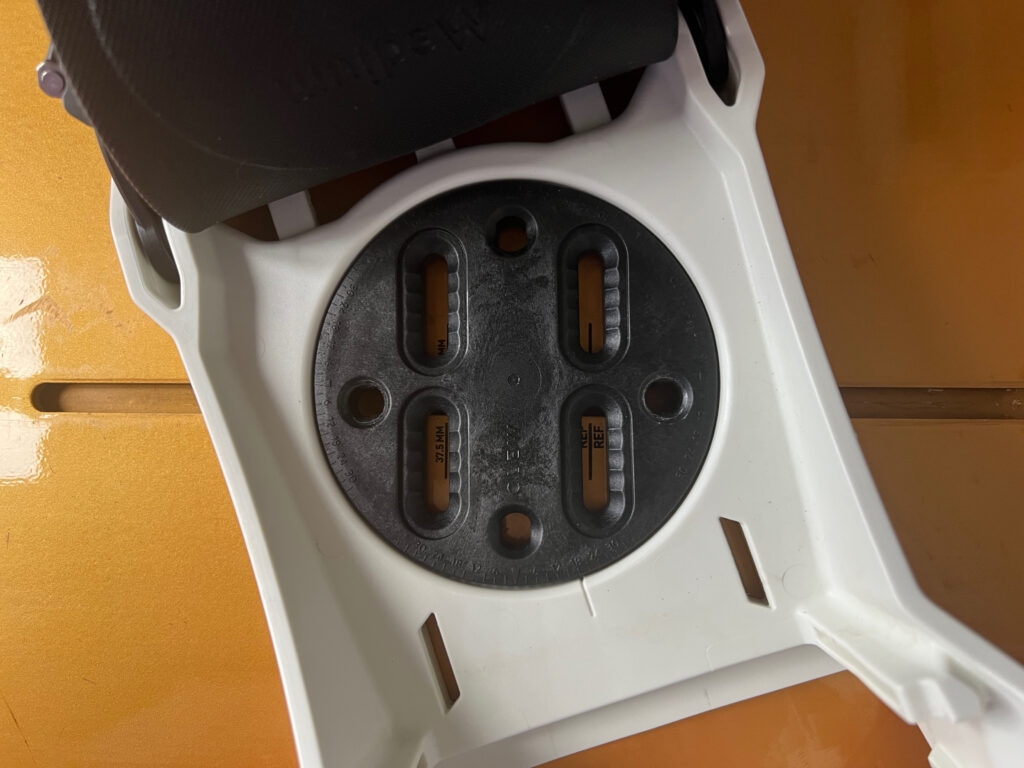
Channel users may struggle to centre the bindings on their board. Image: Jamie O’Brien
My US 9.5 boots happen to be perfectly centred already on the large bindings, so this wasn’t a problem for me, but it’s worth knowing before you buy if you need good adjustment.
The footplate and toe pad are enormous. My boot sole sits a full 3cm off the topsheet of the snowboard, which is essentially like getting a set of risers thrown in for free. If you’ve got big feet and worry about boot drag, this could be a plus.
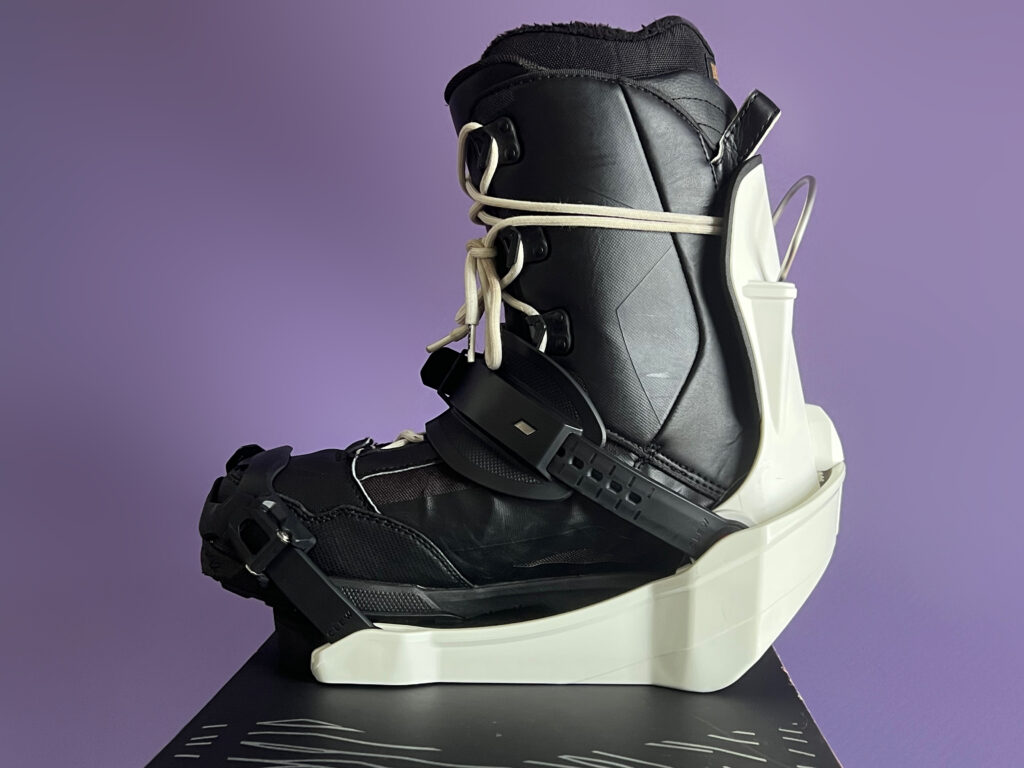
Your boots sit very high, reducing the chances of heel or toe drag. IMage: Jamie O’Brien
Forward lean adjusts via a screw and sliding block, and while I’d have liked a tool-free version, the range works: about 8mm up or down, and at full lean the highback just makes contact with the back of my boot, so there’s no annoying gap before you engage the highback.
Flexing the highback with a boot locked in tells you everything about how these ride. There’s barely any give at all, and laterally there’s nothing whatsoever, not even a fraction of a degree. Compared to my SP bindings, and even my Burton Cartels, the Clews are noticeably stiffer. Your legs are properly bolted to these things.
Stepping In
This is where Clew’s engineering works. Out of the box, setup took no adjustment at all. You just put your boot in, do up the two straps as normal, then use the release bar on the back of the highback whenever you want to step out.
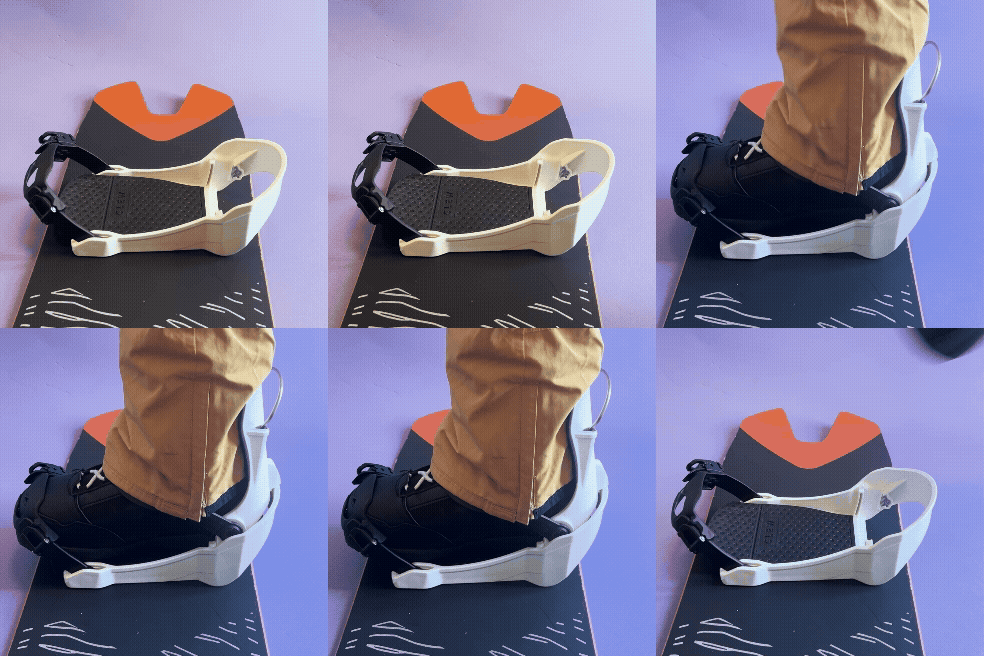
Stepping in and out. Image: Jamie O’Brien
You can also see how this works on snow here.
Stepping in and out is genuinely hard to get wrong. You don’t need to kick your toe forward or line anything up precisely. Two slopes in the heel cup guide your foot in and automatically push your toes under the strap. I tried walking up to my board with my eyes closed and just tapping the back of the binding with my foot before stepping in, and it worked every time. It’s essentially self-locating. For anyone with reduced mobility, vision impairment, or anything else that makes standard bindings a struggle, these bindings could be a huge help (as long as you can bend over to pull the release). Once you’re in, there’s no sense that tightness has been sacrificed for convenience either. It’s properly snug. To step out, you lean over and pull the bar at the back of the highback and lean your foot forward keeping your toe in place. It takes a bit of effort to pull the bar.
The stirrups themselves are bonkers. White plastic against my black boots doesn’t exactly scream inconspicuous, and I couldn’t see myself wandering around the lodge in these unless my pants were baggy enough to drag on the floor and hide them (they do also come in black, green and purple). I did forget to unstrap once and made the error of wearing them to go to the toilet. On the chairlift, though, or when you need to unclip and take a look over a ridge or help someone, I get the appeal of leaving them on. It also works very well just sliding off the lift and stepping in.
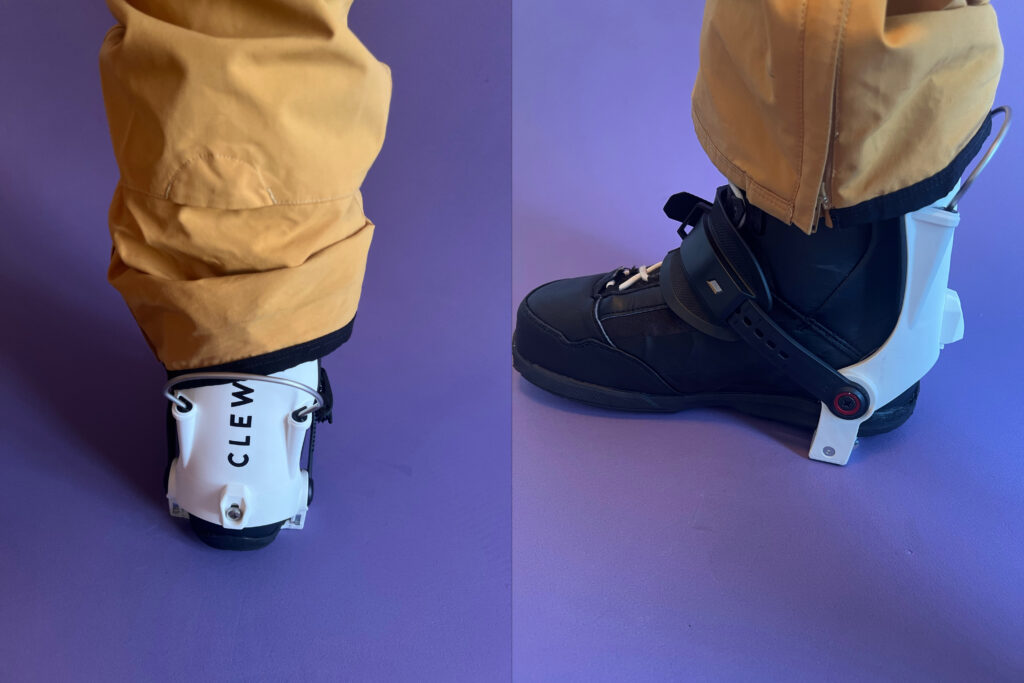
The stirrups without the baseplate. IMage: Jamie O’Brien
Mechanically, it’s a clever solution. The U-shaped stirrup under your heel is a thick, rigid chunk of plastic that locks into the chassis via a steel tooth on either side, each lining up with three separate teeth. That means you have two backup teeth before your foot could actually come loose.
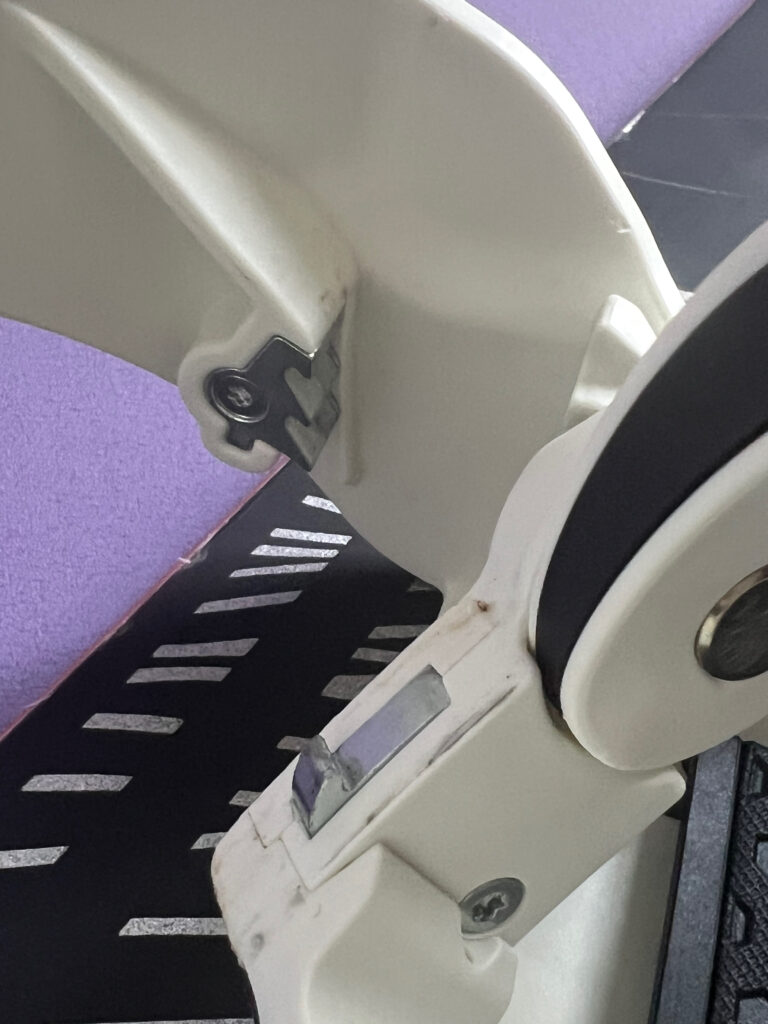
The single tooth on the stirrup next to the three teeth on the baseplate. Image: Jamie O’Brien
Once locked in, there’s zero toe-to-heel movement, as if the two pieces of the binding were moulded as one. These bindings have compromises, like every step-in or rear-entry design does, but toe-to-heel transfer isn’t one of them.
The Straps
A close looks at the staps will make you think, “Why?” They’re thin, hard plastic with none of the padding or hammock-style give you’d expect at this price point, and they feel like something off a rental board. The upside is they’re just screwed on, so swapping them for any generic strap is probably possible. Everything about the padding and straps feels durable rather than comfortable. These are built to last, not to be plush.
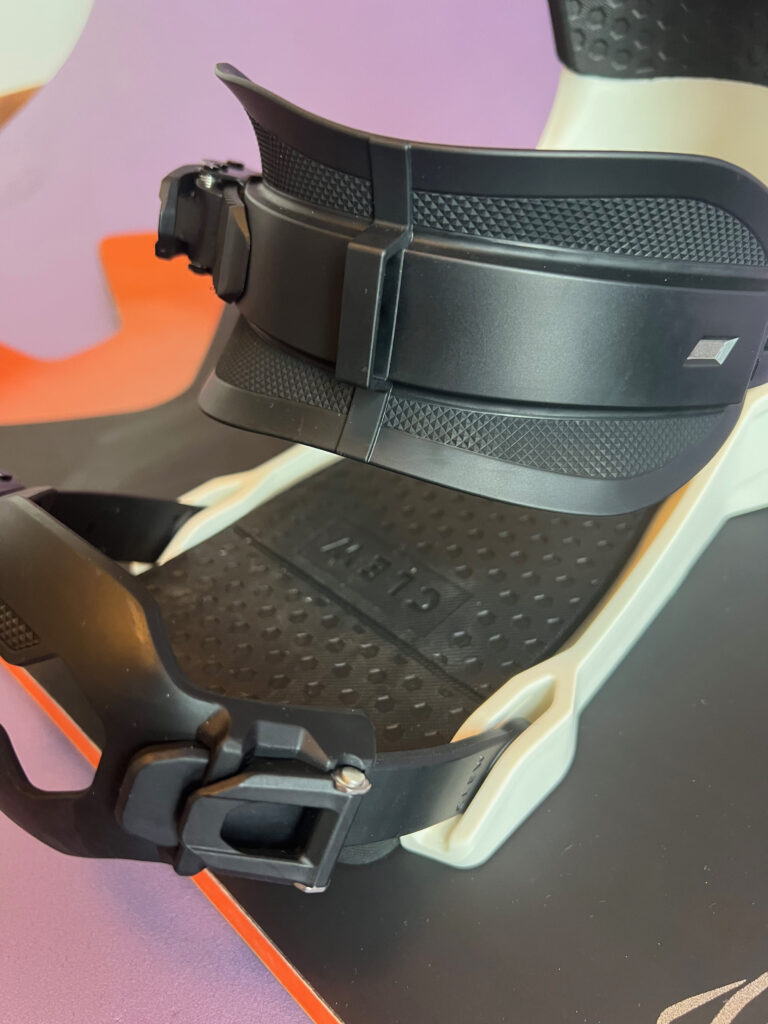
The straps are functional but they seem dated. Image: Jamie O’Brien
It’s worth remembering the first-generation Freedom model had real problems: hardware that stripped, stirrups disengaging, and an overly stiff, harsh ride underfoot. Clew has clearly worked through a lot of that with this second generation, and most of the horror stories still circulating online are about that original model (but the ride is still harsh).
Ride Test
Unfortunately, my day on the snow with these wasn’t great. It took them out at Nozawa Onsen just after Christmas. The snowpack was firm and a little icy in the morning and it softened up later on. No fresh snow. Everything transmits straight through the bar under your back foot, and I got real pain in the heel of my front foot and from the heel strap on my back foot. There’s no under heel padding to speak of.
Normally, if a strap is causing a pressure point, you can adjust it to relieve things, but there’s no such option here. You just have to put up with it. If you’re young and your feet can take it, you might be fine. If you’re older, or you’re used to bindings with good dampening and some give in the straps, it’s rough going.
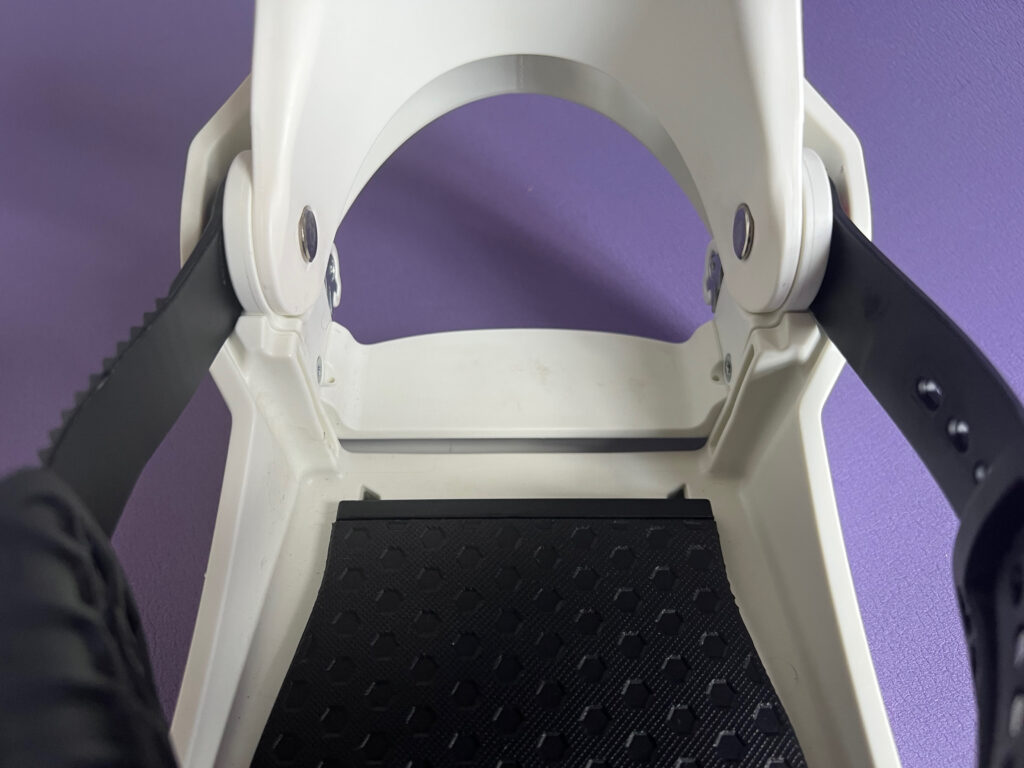
Your boot sits directly on the bar at the bottom of the stirrup. Image: Jamie O’Brien
In terms of performance, riding hard on groomed slopes was fine and the stiffness does mean you have a lot of control. They give you what you would expect from a stiff binding: power, precision, responsiveness and speed edge to edge. (Which is at odds with the marketing pitch at beginners.)
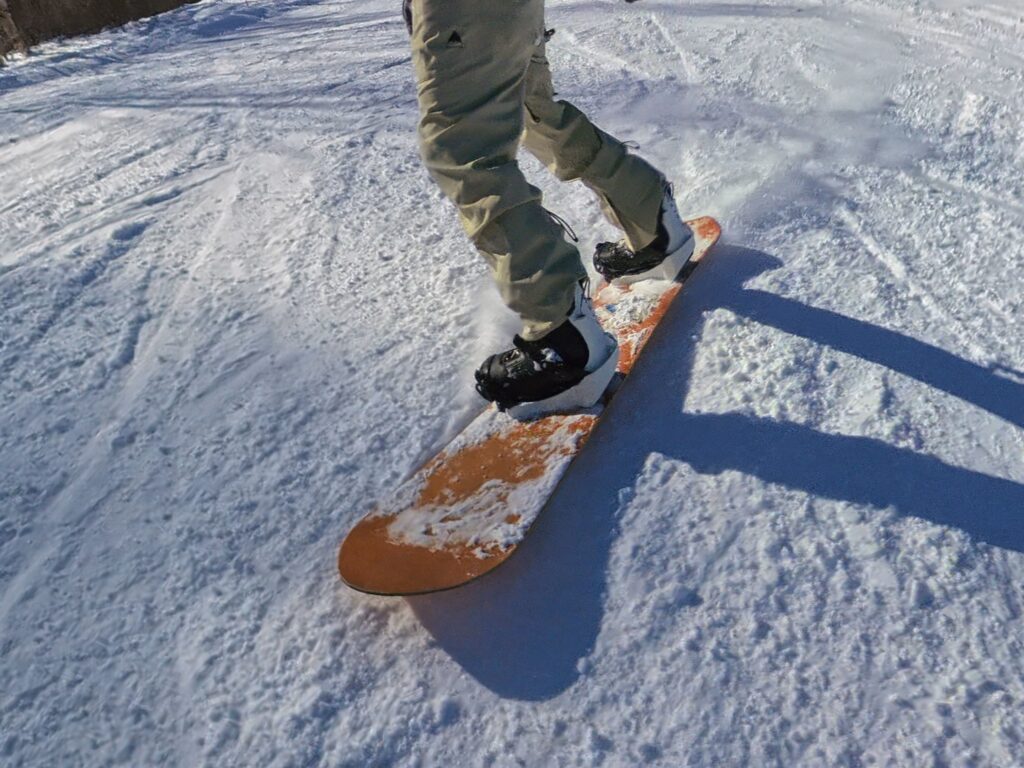
Testing the Clew bindings at Nozawa Onsen. Image: Jamie O’Brien
I can absolutely see the appeal of stepping in, but personally, I prefer rear entry bindings. It feels more natural, and once you’re strapped into a rear-entry binding, you can forget you’re wearing them and the flex and response just feel normal. With the Clews, I never quite forgot they were on my feet.
Who Are These Actually For?
Clew bindings are marketed at beginners, and for that audience, they attempt to solve a real problem: they’re functionally like having ski bindings on a snowboard, which suits anyone who’d rather not deal with sitting and strapping. Weight-wise, they come in at 2.1kg a pair, roughly the same as my SP Peak rear-entry bindings and lighter than the first-generation Freedoms at 2.37kg, though ultralight bindings can go as light as 1.1kg, and normal bindings are in the 1.5 – 2 kg range.
There’s an argument that these can work for riders who don’t struggle with foot pain, do around 20 days a season, and those who get in and out a lot and hate dealing with straps. There are stories of those whose local hill is very flat and requires skating, or only has very short runs, or even parents who need to keep helping their kids absolutely loving these bindings.
There’s an equally strong case against them for serious riders who prioritise swing weight, fine-tuned adjustability, want some padding on their landings, or experience foot pain, where the compromises outweigh the convenience.
The Verdict
Clew’s Independence bindings are a clever piece of engineering with a step-in mechanism that’s about as foolproof as it gets, huge underfoot volume that acts like built-in risers, and toe-to-heel rigidity that rivals a normal two-strap setup. However, the straps are poor, there’s no dampening to speak of in the heel, and the lack of adjustability, especially for Channel users and anyone dealing with pressure points, is a real limitation.
The concept is still a work in progress. The second generation has fixed some problems, but for me, and for anyone who values comfort and adjustability, they’re not there yet. They can work for some people with particular needs who don’t see anything I’ve talked about here as a big deal.
If the next generation has better straps and they can work out a way to add more flex and dampening, as well as making the stirrups feel a bit less bulky underfoot, I’d love to give them another try.
PARTNER WITH SKI ASIA
 Put your business in front of half a million real skiers
Leverage Ski Asia’s audience of more than half a million skiers globally to drive more traffic and demand to your winter season business.
The Author

You Might Also Like