


Ski Asia dug through decades of official snowfall data for Niseko and Nozawa Onsen to test whether El Niño actually affects a Japanese ski winter. In Niseko, it doesn't – at least not in the way the headlines suggest. Nozawa Onsen is a different story.
By now you’ve probably seen the coverage. In its most recent outlook, the Japan Meteorological Agency put the odds of El Niño lasting through the coming winter at 100%, and the numbers behind that call are genuinely striking: sea surface temperatures are expected to keep climbing into winter, potentially reaching levels last seen in 1997 – the strongest El Niño ever recorded. Some outlets are already calling it a Super El Niño.
If you’ve got a Japan ski trip booked and you’ve read any of that coverage, the natural next thought is: should I be worried?
We’re not meteorologists or climate scientists – just a ski media outlet with an interest in the data. So rather than guess, we checked, using decades of official snowfall and snow depth records from the Japan Meteorological Agency (JMA), the same government body behind that outlook.
What the Niseko data actually shows
El Niño is a warm phase of the tropical Pacific that reliably reshapes weather patterns across large parts of the world, and Japan is genuinely one of the places it affects. The conventional wisdom – repeated across ski forecasting sites every autumn – is that El Niño winters bring a weaker East Asian winter monsoon, fewer cold outbreaks from Siberia, and less snow.
That relationship is real. But it’s not evenly real across Japan, and Niseko sits in the part of the country where it barely shows up at all.
We classified every one of the 73 seasons in our Niseko snowfall dataset by its winter ENSO phase, using NOAA’s official Oceanic Niño Index, and compared total seasonal snowfall across El Niño, La Niña, and neutral years.
| ENSO Phase | Seasons | Average Season Snowfall |
|---|---|---|
| El Niño | 26 | 1,145cm |
| La Niña | 27 | 1,157cm |
| Neutral | 20 | 1,141cm |
The difference between El Niño and La Niña seasons is about 1% – statistically indistinguishable from noise. Neutral seasons average slightly less than either, but the gap is trivial across every possible pairing, under 1.5% in all directions. Three of the five snowiest seasons in the entire 73-year record were El Niño years – including 1969/70, still the single best season Niseko has ever had.
Why Niseko is different
Japan’s heaviest snow comes from cold, dry Siberian air crossing the Sea of Japan, picking up moisture, and dumping it as orographic snow when it hits the coast. El Niño’s main effect on Japan works by weakening the monsoon system that drives that cold air south in the first place. But Hokkaido’s snow supply draws on a broader set of atmospheric patterns than Honshu’s does, which dilutes El Niño’s individual influence. The Grasshopper, Mountainwatch’s long-running Japan snow forecaster, puts a number on the gap directly: roughly 5% less snow for Hokkaido in an El Niño year, against roughly 10% less for Honshu. A peer-reviewed study on Sapporo’s winter climate reached a similar conclusion from the academic side, describing the relationship between El Niño and Hokkaido’s snowfall as “complex” precisely because so many local factors compete with the global signal.
“Three of the five snowiest seasons in the entire 73-year record were El Niño years – including 1969/70, still the single best season Niseko has ever had.”
In short: the mechanism behind the “El Niño means less snow” headline is real, but it’s a Honshu story more than a Hokkaido one.
What about Nozawa Onsen?
We ran the identical test on Nozawa Onsen, using the 41 seasons in our dataset with a fully complete daily record, dating back to 1980.
| ENSO Phase | Seasons | Average Season Snowfall |
|---|---|---|
| El Niño | 13 | 1,004cm |
| La Niña | 18 | 1,237cm |
| Neutral | 10 | 1,044cm |
This time there’s a real gap: La Niña seasons averaged 233cm more snow than El Niño seasons, a 23% difference – a world away from Niseko’s 1%. But that headline number is misleading on its own. Comparing all three groups individually shows where the gap actually comes from:
| Comparison | Difference |
|---|---|
| El Niño vs. Neutral | −3.9% |
| La Niña vs. Neutral | +18.5% |
| El Niño vs. La Niña | +23.3% |
El Niño seasons and neutral seasons are nearly identical – 1,004cm against 1,044cm, under 4% apart. The real outlier is La Niña, which runs about 18% above a normal year. In other words: this isn’t El Niño suppressing Nozawa’s snowfall so much as it’s La Niña boosting it. For anyone planning a trip in an El Niño winter specifically – which is what’s forecast for 2026/27 – that’s a meaningfully more reassuring way to read the result. You’re not looking at a penalty. You’re just not getting La Niña’s bonus.
Here’s the honest caveat, in plain terms. When statisticians test whether a pattern is real or just a coincidence in a limited dataset, they look for a result that clears a standard bar of confidence. None of these three comparisons clears that bar on their own – La Niña versus neutral comes closest, but even that carries real uncertainty. In practice, that most likely means the La Niña effect is real but our dataset, at 41 complete seasons split three ways, isn’t yet large enough to nail any one comparison down with total certainty. What we can say with more confidence is the shape of the pattern: El Niño looks like an ordinary winter for Nozawa, and it’s La Niña that’s the outlier.
It’s also worth being clear about what any of these averages do and don’t mean for any single winter. They’re differences between group averages, not a guarantee for any individual season – and some of Nozawa’s strongest winters on record happened during El Niño years. 1986/87 was a strong El Niño and still delivered 1,735cm, close to Nozawa’s all-time best season on record.
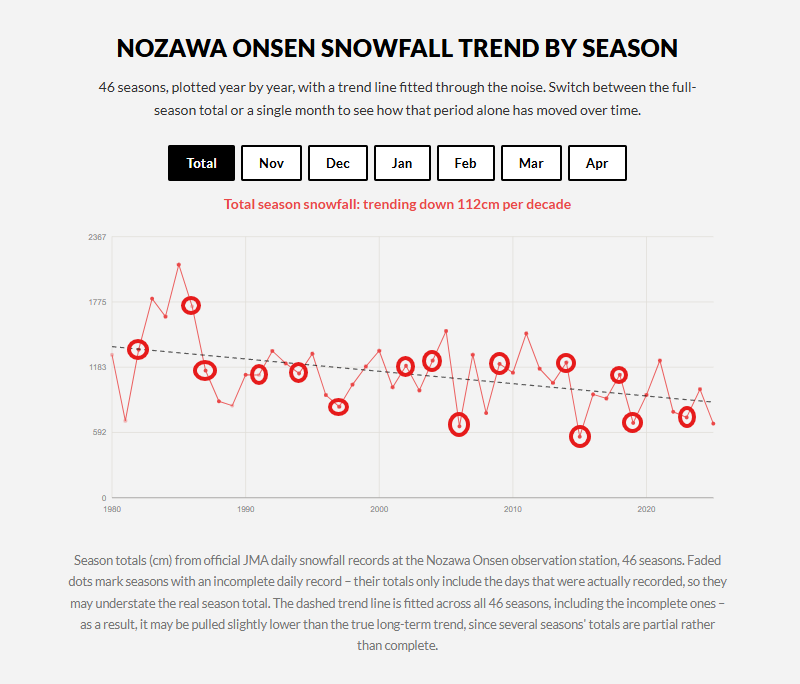
Nozawa Onsen’s El Niño years are circled in red. View Ski Asia’s Nozawa Onsen snowfall data hub
The bottom line
If you’re planning a Niseko trip for winter 2026/27 and the Super El Niño headlines have you second-guessing it, our own decades of official data say you can relax. El Niño’s well-documented effect on Japan’s snowfall is real, but it lands on Honshu harder than it lands on Hokkaido – and some of Niseko’s best seasons ever have happened during El Niño winters, not despite them.
Nozawa Onsen tells a more nuanced story. There is a real gap between its La Niña and El Niño seasons – 23%, against Niseko’s roughly 1% – but breaking it down shows that gap is coming from La Niña delivering a bonus, not El Niño taking anything away. Nozawa’s El Niño seasons and its ordinary, neutral seasons are barely distinguishable, under 4% apart. If you’ve got a Nozawa trip booked for this coming winter, that’s genuinely reassuring: the data suggests you’re heading into something close to an ordinary season, not a below-average one – you’re just not getting the extra boost a La Niña winter might have delivered instead.
None of this is a reason to reconsider a trip to either resort outright. Both remain, by any reasonable global standard, exceptional places to ski. But skiers who plan carefully deserve to plan with real information rather than folklore – and on this particular question, Niseko and Nozawa Onsen genuinely don’t tell the same story.
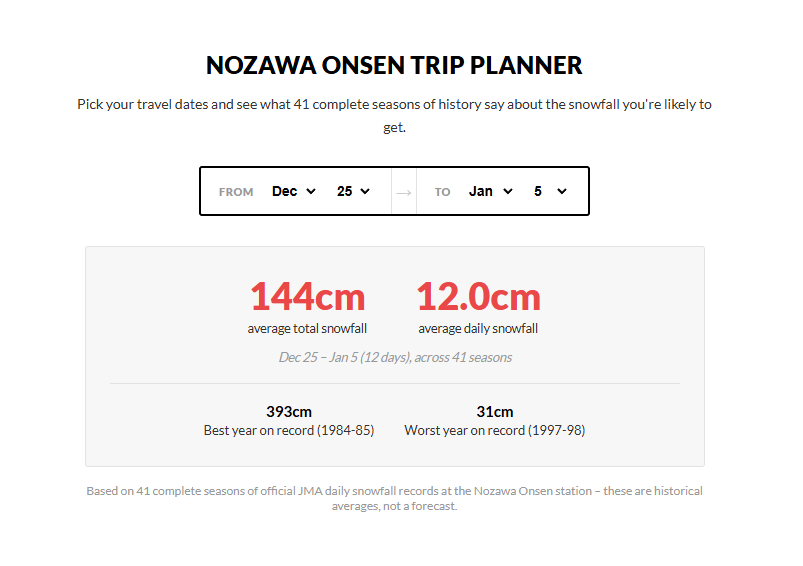
Try our new Nozawa Onsen Trip Planner
Explore the full dataset yourself →
Niseko snowfall data
Nozawa Onsen snowfall data
Data: Japan Meteorological Agency. Compiled and analysed by Ski Asia.
ENQUIRE NOW
 Organise your guided backcountry skiing tour in Japan
 Organise your guided backcountry skiing tour in Japan
There are lots of options in Hokkaido and Honshu that can be tailored to the kind of skiing you like and when you plan to come. Answer a few questions and we’ll get back to you with some recommendations.
You Might Also Like