


Many know Iiyama for its Shinkansen station, but very few consider it as a place to stay. Which is odd, because it probably has the best access to ski resorts of any town in Japan.
Getting a good hotel for a reasonable price in the popular resorts around Nagano, like Nozwa Onsen, Madarao, Shiga Kogen or Myoko Kogen has become incredibly difficult in the last few seasons. Prices have rocketed, there seem to be fewer properties on the main booking platforms, and even seven or eight months ahead of the season, you’re panicking because you can’t find anything suitable.
Is a small tatami room with a shared bathroom in a rundown guesthouse that’s a 20-minute walk from the lifts really worth ¥50,000 a night?
No is the only sane answer to this question. Personally, I’d much rather spend some of that money on an SUV (around ¥100,000 – ¥200,000 for a week depending on specs) and stay just a few minutes down the road for ¥12,000 a night in a town without the pressure of overtourism, where there are restaurants, bars, supermarkets, and winter sports stores, and Japanese customers paying Japanese prices. Then I can drive to a choice of ski resorts each day rather than be locked into one resort.
Fortunately, Iiyama, a small city positioned in the flatlands, right in the centre of Nagano’s famous ski resorts, is the perfect spot. It’s not really a “secret”, as most visitors to the area know it for the Shinkansen station that gives access to the region, but hardly anyone thinks of it as a place to stay, or a place to buy property.
That’s odd, because Iiyama probably has the best access to ski resorts of any town in Japan, and, as I found out on a recent trip, it’s home to one of the more interesting ideas in Japanese ski accommodation: high-end tiny homes.

Would you stay in a tiny home on a ski trip? Image: ikigaico.jp
This guide covers both using Iiyama as a base to explore the ski resorts, but also the huge opportunity that exists right now. Iiyama is absolutely ripe for investing in property, and for local business owners to upgrade their offerings. Those who have so far only attracted local tourists can easily upgrade and expand their accommodation to attract international guests who are more than willing to pay hundreds of dollars a night.
Why Iiyama makes sense as a base
Iiyama sits in northern Nagano, in what is one of the snowiest inhabited parts of Japan. It obviously isn’t a resort town. It’s a proper small city with a train station, supermarkets, restaurants, bars, stores and a permanent population going about their normal lives. It’s also right in the middle of an unparalleled cluster of ski resorts.

Myoko’s resorts regularly see over 14 metres of snow a season. Image: opensnow.com
From the north of Iiyama, you’re only five minutes from Nozawa Onsen and nine minutes from Togari Onsen. From the centre, near the station, you’re about 20 minutes from both Nozawa, Togari and Madarao, and around 45 minutes from the Myoko Kogen cluster of five resorts to the west as well as Arai and Togakushi (if the roads are clear, which they usually are). To the southeast, X-JAM, Cupid Valley, Ryuoo Ski Park and Yomase Onsen are all within a 25-minute drive. Beyond that, Sun Valley, the gateway to the vast 18-area Shiga Kogen network, is about 40 minutes away.

The terrain on offer at Ryuoo Ski Park, a short drive from Iiyama. Image: Jamie O’Brien
That’s at least 15 separate ski areas well inside an hour, including Shiga Kogen, the biggest interconnected resort network in the country. There isn’t another base town in Japan with that kind of spread on the doorstep. Compare this to other popular multi-resort bases: Omachi and Morioka each give you access to around nine resorts, Yuzawa, Inawashiro and Asahikawa around eight, Otaru five, Kutchan just two, and in some of those towns you’re looking at more than an hour’s drive to reach the furthest resorts in the cluster. Most of those options only have one or two high-profile resorts, Iiyama has five and beats all of those locations on count, variety and convenience.
The station sits directly on the Hokuriku Shinkansen line, with Tokyo reachable in just 1 hour and 39 minutes, and has direct bus services to all the major resorts. That’s crazy for a town with so little attention. Iiyama is still very underdeveloped when it comes to accommodation built for international travellers, but crucially, it isn’t a ghost town in winter either.
Getting to Iiyama and getting around
From Tokyo Station, the Shinkansen drops you right in the middle of town. Unlike some ski destinations, here the buses are timed to sync perfectly with the early-morning Shinkansen services so that you can get the resort bus and be in-resort in time for the first lift.
Iiyama itself is walkable, but to make the most of that huge cluster of resorts, having your own wheels means you can wake up and pick whichever mountain has the best snow report that morning. Rental cars are available in town, and there are more options in nearby Nagano (book ahead). The roads around Iiyama are well maintained through winter, with studless winter tyres fitted as standard and AWD available. The longer drives to Madarao or Shiga aren’t particularly difficult, but the lightness of the snow means AWD is essential if you don’t want to get stuck. It’s also useful for getting out of the car park after a huge dump.

Many cars got stuck exiting the car park at Akakura Kano when we visited. IMage: Jamie O’Brien
You’re highly unlikely to have a problem parking at any of the resorts here. Even Nozawa at New Year wasn’t an issue, and I found parking much easier than the walk to the lifts when staying in the village. You might have to drive around a little at Shiga during peak season, but here there’s always another village and another car park somewhere in the network. I’ve never not been able to park at a resort in Japan.
Ski resorts within reach of Iiyama
There’s so much variety here. It’s a full cross-section of everything that Japan has to offer: empty local resorts with deserted steep off-piste zones, runs to suit beginners and experts, and glitzy international resorts. You’ve also got a world-class terrain park, snowsure high altitude, and wind-protected backup options.
Nozawa Onsen – 20 minutes’ drive from central Iiyama
Nozawa Onsen is the famous resort town in the area. It’s large by Japanese standards, with 36 marked trails across 297 hectares with a vertical drop of 1,085 metres and a high-speed gondola that minimises queuing times. The village itself is a proper onsen town, with more than a dozen free public baths dotted around. It’s the resort with the most restaurants, the best nightlife, and the most polish of anything on this list, which is also why it’s busy and why accommodation there is so hard to find. It has a good mix of local businesses and foreigner-run establishments. For tips on where to eat and bathe, see: A perfect day in Nozawa Onsen with Peter Douglas, head of Nozawa Hospitality.

The deserted Skyline course at Nozawa Onsen runs along a ridgeline. Image: Jamie O’Brien
Togari Onsen – 20 minutes
Togari Onsen sits directly across the valley from Nozawa. It’s a mid-sized resort with around 13 trails and 650 metres of vertical, split across two zones, with wide, gentle slopes that make it popular with beginner snowboarders on weekends. It used to be almost entirely a locals’ hill, and while a few foreigners have bought property at the base in recent years, it’s still uncrowded. It’s an onsen and an early-night kind of place if you’re staying there, but that doesn’t matter for a day trip.
Madarao Mountain Resort – 15 minutes
Madarao Mountain Resort is great if you’re chasing powder and love being in the trees. It’s a compact resort, but it sits in a natural bowl that catches a huge amount of snow, and around 60% of its 31 runs are left ungroomed. The lift-accessed tree skiing here is some of the best in Nagano, with officially designated zones. It connects at the top to Tangram Ski Circus via a joint lift pass, and takes the combined terrain to 125 hectares across both resorts. There are a handful of nightlife options (check out Mister Daruma and book early) but it can be worth staying overnight here at the end of your trip, just to get a taste of things in the village. I recommend Active Life Madarao. Get in touch with La Colina for reasonably priced guided tours here and around Nagano, or Kamoshika Snowsports for private lessons at a choice of resorts in the area.

Madarao’s pistes are uncrowded. Image: Jamie O’Brien
Myoko Kogen – 30 to 40 minutes
Myoko Kogen is actually five separate resorts. Akakura Onsen and the adjoining Akakura Kanko form the main hub, where most of the accommodation, bars and restaurants are. Ikenotaira is the gentlest of the five, good for building confidence in powder without much steep terrain to contend with.

Mid-afternoon fresh tracks at Ikenotaira. Image: Jamie O’Brien
Myoko Suginohara has one of the longest runs in the country at 8.5km, plus a decent powder zone up top for advanced riders. Seki Onsen is the smallest with just a couple of chairlifts, but it has become a powder hunters’ favourite for its deep snow and relaxed attitude to going off-piste. It’s a powder frenzy each day when they eventually open the top chair.

Deep powder right off the lift at Seki Onsen. Image: Jamie O’Brien
Arai Snow Resort – 45 minutes
Arai, three-time winner of Ski Asia’s best ski resort award, is the luxury option. It sat dormant for over a decade before the Korean hotel group Lotte bought it and reopened it in 2017 as a fully overhauled, high-end resort. What makes Arai stand out is how much of the in-bounds terrain is designated free-ride zone, which gives you a huge amount of accessible off-piste.

You know you’re in the right place when you’re getting more snow than Kiroro. Image: opensnow.com
It gets up to 18 metres of snow a season, and on a clear day you can see the Sea of Japan from the top. It gets very, very busy on a powder day, so get there early and get your ticket before the crowds arrive.

Myoko Snowsports also operates out of Arai and offers freeride tuition. Image: Jamie O’Brien
Togakushi – 45 minutes
Togakushi is over by Nagano City, but it’s well within range and belongs on this list for a completely different reason to the rest. It’s a small resort, with 7 lifts, 19 courses, 548 metres of vertical, with a decent mix for beginners through to advanced riders.

One of the short but sweet black runs at Togakushi. Image: Jamie O’Brien
What sets it apart is what’s right next to it: Togakushi Shrine, one of Japan’s most revered spiritual sites, with a pilgrimage path through cedar trees more than 400 years old leading up to the Okusha inner shrine. Ski in the morning, visit the shrine in the afternoon, and finish with a bowl of the local handmade Togakushi soba. It’s not somewhere to base a whole trip, but as a one-off day away from the usual powder chase, nothing else on this list comes close.

Togakushi shrine is well worth a visit. Image: Jamie O’Brien
X-JAM Takaifuji and Yomase Onsen – 25 minutes
These two sit right next to each other in Yamanouchi, and a single lift ticket covers both. X-JAM is more of a terrain park built into a mountain than a conventional resort, with two half-pipes and a snowboarding crowd, while Yomase brings a bit more variety with curving, tree-lined runs. It’s compact, easy to ski quickly, and not somewhere you’d base yourself, but it’s a good option if part of your group wants park laps while the rest want easy runs.
Cupid Valley – 25 minutes
Officially called Yukidaruma Kogen but almost always referred to by its English name, Cupid Valley is a small, family-friendly resort just over the border in Niigata. It has around 12 courses and only a handful of lifts, including what’s now one of the fastest quad lifts in Japan following a recent extension. It sits under near-constant snowfall, with snow walls along the approach road that can reach three metres high, and because it attracts mostly local families rather than tourists, there’s very little competition for powder. Again, this is a day-trip resort rather than somewhere to stay.
Ryuoo Ski Park – 25 minutes
Ryuoo is the largest of this small cluster of resorts known as Kita-Shiga Kogen, and it’s almost entirely off the radar for foreign visitors despite being extremely popular with locals. They come in by the busload but mostly stick to the green runs (look out for out of control teenagers trying to teach themselves to snowboard). Its standout feature is the Skyland Express ropeway, one of the biggest gondola cabins in the world, capable of carrying 166 passengers up to the Sora Terrace observation deck at 1,770 metres, where you can look out over a sea of clouds. Below that it’s a long, narrow resort with a serious 1,000 metre-plus vertical drop, powder-friendly northwest facing slopes, and a gigantic powder zone with steep well-spaced trees that hardly anyone seems interested in (the entry point is a steep wall).

The top of the ropeway at Ryuoo and the entry point to 1,000m of vert. Image: Jamie O’Brien
You have to register at the terrace and get a sticker on your helmet to pass through the guarded entrance. Go there early, register, and lap this until it’s tracked, then get out.
Shiga Kogen – 40 minutes
Sun Valley is the closest point and the gateway to Shiga Kogen, Japan’s largest interconnected ski area. It’s made up of at least 18 linked ski fields covering everything from gentle family runs to the steep, narrow former Olympic courses used at the 1998 Nagano Games. Shiga Kogen has a reputation for being very Japanese and undeveloped for international visitors, which some people love but others who want English-speaking nightlife find baffling. I’ve written in detail about the Shiga Kogen area, including the northern Okushiga Kogen and Yakebitaiyama peaks in this guide to Okushiga Kogen, which also covers the wider Shiga Kogen network.

The top of the Giant Olympic course at Shiga Kogen. Image: Jamie O’Brien
Where to stay in Iiyama City
Iiyama has nothing like the density of accommodation you’d expect for a town with this much terrain on its doorstep. I’ve included rough prices (as of August 2026) for a stay in January or February but these may not be accurate as they can change very quickly. I still think it’s useful to see what’s possible compared to in-resort prices.
North Iiyama, minutes from Nozawa and Togari, has Kamakura, a guesthouse (Around ¥20,000 a night), plus Iiyama Houses (from ¥36,000 per night for a 2-bed property) and North Nagano Inn (around ¥45,000 a night for a 2-bed apartment). Rooftop Hideaway Nozawa is a luxury four-bed property that sleeps up to 12 and is currently only ¥28,000 to ¥32,000 a night in peak season (launching this winter, but currently taking bookings from January). Ikigai Collective’s beautiful tiny homes are also here (from around ¥27,000 per night). North Iyama is right between Nozawa and Togari ski resorts and within a 5-10 minute drive.
Central Iiyama, close to the station, has more variety. Business Hotel Noble Iiyama and Hotel Hoteiya are the town’s two proper hotels that can be booked online, both very basic business hotels. Oaiso オイソ and T&T Fujiyama MC2 are guesthouses, and Iiyamakan is a small ryokan (all in the ¥6,000 – 10,000 per night bracket). KOKUTO iiyama home and Yukuru 遊来 are basic hostels/guest houses (around ¥4,000 – 6,000). If you’re someone who’s looking for that 1990’s budget Japan hostel ski tour vibe, it lives on here.
West Iiyama has Asahi House, a renovated traditional six-bedroom house (around ¥115,000 a night in peak season). In the east, neighbouring town Kijimadaira has the guesthouse Otowa 音和 (¥25,000 per night).
You can also find cheap rooms for rent on Airbnb.
Eating and drinking
Iiyama has plenty of bars and restaurants, and while it’s normal in mountain cities for some places to close in the winter, Iiyama provides enough to eat well for a week at local, un-touristy places. They also get enough people passing through in the centre of town to be accustomed to non-Japanese-speaking diners. (My tip is, put “please serve us your best dishes” into Google Translate. It usually works well and it’s cheap enough to not worry about prices.)
Restaurant Kamakura Village serves hotpot inside an igloo. It’s open in winter only and popular, so book ahead. Iiyama Ekinaka Sakaba Eppe (飯山駅ナカ酒場えっぺ) is handy for a drink and a bite before your train. Waremokou does excellent Japanese cuisine and Kyoto-style obanzai, while イナリ食堂 is a simple community diner. Hananoya, Matsumi Sushi and Satomi have all the Japanese classics covered, and 江戸前手打蕎麦しおいり is the pick for handmade soba.
For drinks, head to Minamimachi (南町), a 10 to 15 minute walk from the station where you’ll find a good cluster of bars. Fujimo is a solid izakaya. Bar End (バル.エンド) is the standout, a cosy European-style bar with a decent wine list. BAR ROUND has darts, karaoke and a younger crowd, while Yamaji (歌謡スナック山路) is a classic retro snack bar with communal sing-along karaoke.
Rentals and retail
Iiyama has no rental shops, so rent gear at whichever resort you’re visiting. Joey’s in Myoko Akakura is great for high quality demos. Spend your first and last days at the same place to simplify returns. For retail equipment and servicing, S-Cube in Shizuma, run by domestic manufacturer Swallow Ski, does proper waxing, sharpening and tuning. For lessons, Japan Snowsports meets you at whichever resort you’re skiing that day, useful if you’re switching between mountains. Tsuruya Iiyama is a big supermarket near the station and has cheap local wine, beer and bento for a fraction of resort prices.
The tiny home investment opportunity
Iiyama has better multi-resort access than almost anywhere else in Japan and genuinely affordable land, yet its accommodation stock is stuck a decade or three behind the nearby resorts. Nozawa Onsen next door is bursting at the seams with nowhere left to build. Iiyama has the space, but is underdeveloped.
I wrote in detail a few weeks ago about Ikigai Collective, a tiny home manufacturer based in Iiyama. Ikigai builds high-end tiny homes on trailer bases, engineered for Japan’s heavy snow regions. I stayed in one of their showroom units, and it was one of the best-designed small spaces I’ve stayed in on any ski trip. It’s fully self-contained, properly insulated, and built well above the standard of the shipping-container tiny homes you see elsewhere.
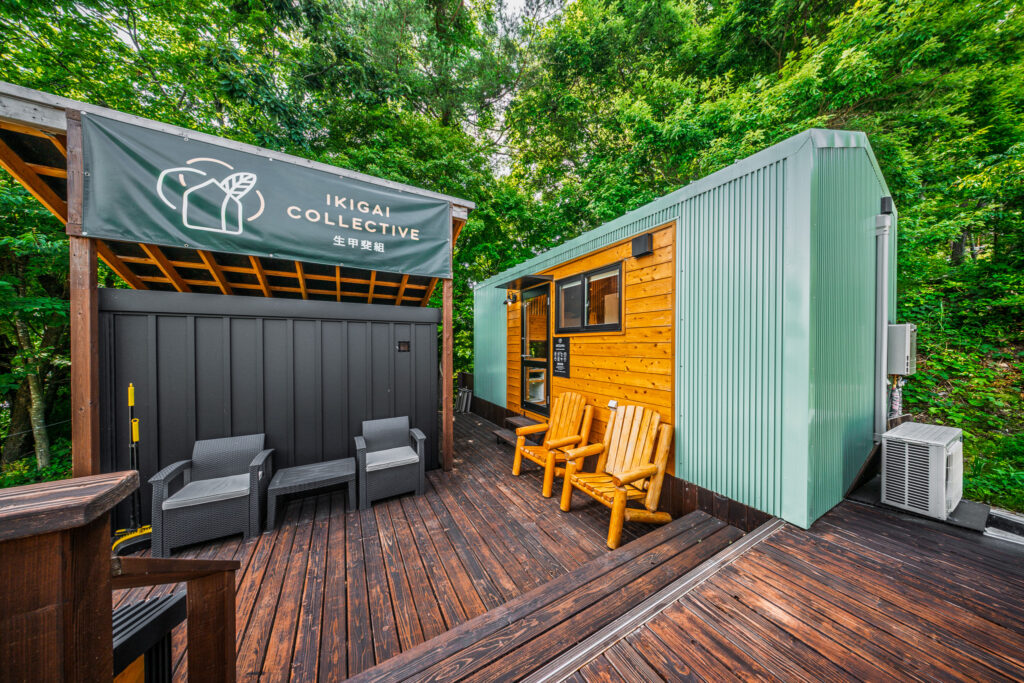
Ikigai Collective’s innovative tiny homes, based in north Iiyama. Image: ikigaico.jp
Ikigai’s showroom village is bookable as regular accommodation, and it’s one of the more interesting places to stay in the area. And if you have any interest in investing in property in Japan, it’s a great way to try before you buy. A night or two gives you a genuinely accurate sense of what living in a tiny home is like, how the layout works, and how the insulation copes with Nagano winter storms.
A tiny home is about the fastest way to add inventory to a guesthouse property that exists in Japan. Because Ikigai’s units are built on a trailer chassis, they’re legally classified as vehicles rather than permanent structures, sidestepping most of the planning and construction bottlenecks that make a normal Japanese build painfully slow. A lodge owner needing extra staff accommodation, or wanting to add a couple of premium guest units to an unused corner of a car park, can do so in a matter of weeks.
Given how thin Iiyama’s accommodation is relative to its surrounding ski areas, there’s an obvious opportunity to differentiate without the capital outlay of a full hotel build. It’s also a neat solution for the akiya renovation problems common across rural Nagano: just clear the site and drop in units. And with Ikigai based right next door, you’re perfectly set with their end-to-end service and support. It couldn’t be simpler.
Land in Iiyama is still genuinely cheap, even by Japan’s standards. If a house is beyond saving, demolishing and dropping in pre-built tiny homes makes sense. Ikigai’s team can handle everything from town council negotiations to teardown, site clearing and utility hook-ups.
Who is Iiyama for?
“No purpose-built village, no strip of international bars, no English menus and Tokyo prices, just a real Nagano town that happens to sit in the middle of some of Japan’s best ski resorts.”
Iiyama isn’t trying to cater to ski tourists and that’s exactly why it’s a draw. No purpose-built village, no strip of international bars, no English menus and Tokyo prices, just a real Nagano town that happens to sit in the middle of some of Japan’s best ski resorts.
If you want the polish and nightlife of Niseko or Hakuba, Iiyama isn’t for you (but Nozawa is there whenever you want a taste of that). If you’d rather base yourself somewhere affordable and quiet for a road trip that has a genuinely local feel and the flexibility to ski a different mountain every single day for two weeks, then Iiyama is for you.
ENQUIRE NOW
 Organise your guided backcountry skiing tour in Japan
 Organise your guided backcountry skiing tour in Japan
There are lots of options in Hokkaido and Honshu that can be tailored to the kind of skiing you like and when you plan to come. Answer a few questions and we’ll get back to you with some recommendations.
The Author

You Might Also Like