


The Japan Meteorological Agency has released its Winter 2026/27 outlook. It points to a milder winter than normal across most of the country, with an elevated chance of below-normal snowfall along the Sea of Japan coast. What follows is what the numbers actually say, and what they mean for a trip already booked.
JMA issues every seasonal outlook in the same fixed format: three categories per region – below-normal, near-normal, and above-normal – each originally defined so that it occurred in roughly a third of seasons over the historical reference period. The forecast itself is JMA’s models putting more or less weight on each of those three categories for the winter ahead. A region sitting at 50:30:20 means the models are placing half their weight on a below-normal outcome, well above that category’s roughly one-in-three historical baseline.
What the maps show
For snowfall, JMA only issues a specific figure for the regions that sit directly on the Sea of Japan coast, where nearly all of Japan’s serious snow actually falls. Every one of those Honshu regions – Tohoku, Hokuriku, Kinki (Sanin) – sits at 50% below-normal, 30% near-normal, 20% above-normal. Put another way, there is a 50% chance of a below-normal winter there, against an equal 50% chance of normal or better.
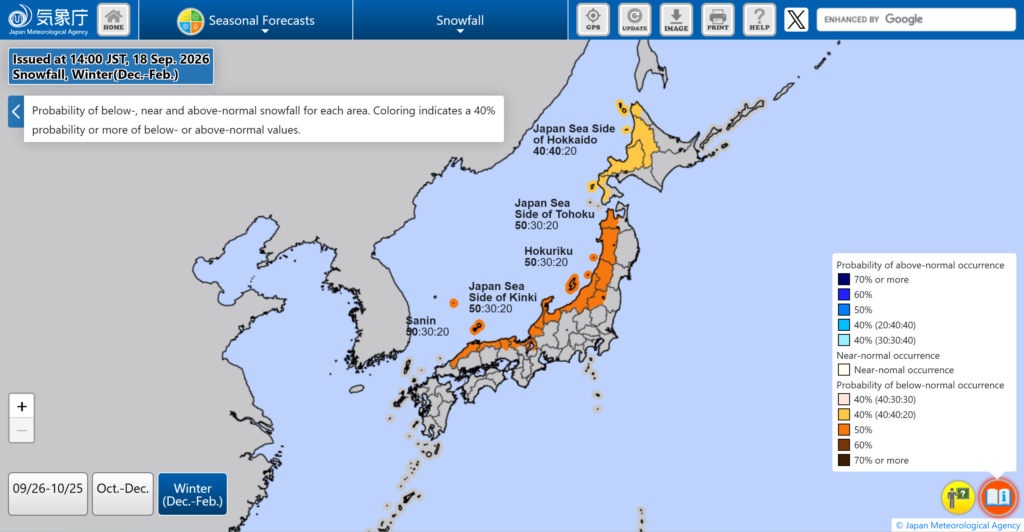
Issued at 14:00 JST, 18 Sep. 2026. Average snowfall, Winter(Dec.-Feb). Japan Meteorological Agency
Hokkaido’s Japan Sea side, where Niseko sits, is more evenly balanced: 40% below-normal, 40% near-normal, 20% above-normal. Below-normal and near-normal are tied as the most likely outcomes, both well ahead of above-normal, but combined, normal-or-better still outweighs below-normal, 60% to 40%.
Worth noting directly: JMA does not publish a Dec–Feb snowfall figure for Kanto-Koshin at all, so there is no official number to apply to Nozawa or the rest of Nagano’s resorts specifically. Given the strength of the warm lean in that region, and how consistently the neighbouring Sea of Japan regions lean toward below-normal snow, it would be reasonable to expect some of the same pressure there – but that is inference, not something JMA has stated, and it is presented here as such.
For average temperature, the lean this winter is emphatic across most of Honshu. Hokuriku, Kanto-Koshin (home to Nagano and Nozawa Onsen), Kinki, Chugoku, Tokai and Northern Kyushu are all sitting at the same reading: 10% below-normal, 30% near-normal, 60% above-normal. Tohoku is a shade softer, at 20% below-normal, 30% near-normal, 50% above-normal. Hokkaido carries the mildest lean of the group: 20% below-normal, 40% near-normal, 40% above-normal – still tilted warm, but with normal-or-below outcomes just as likely as above-normal.
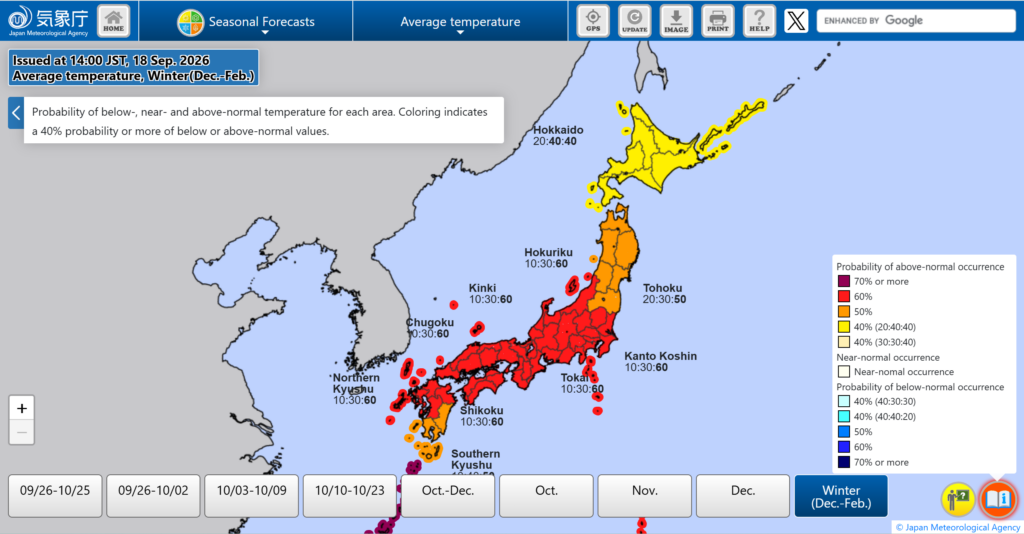
Issued at 14:00 JST, 18 Sep. 2026. Average temperature, Winter (Dec.-Feb). Japan Meteorological Agency
A pattern we have seen before
The Hokkaido-versus-Honshu gap in this outlook is not a new finding. It is the same split we identified when we tested whether El Niño actually affects Niseko’s snowfall using 73 years of official records: Honshu is measurably more exposed to a weak-monsoon, El Niño-driven winter than Hokkaido is, since Hokkaido’s snow supply draws on a broader mix of atmospheric patterns that dilutes any single driver’s influence.
JMA’s current outlook shows that same pattern in the numbers for this specific winter – a stronger warm-and-dry lean across Honshu, a consistently softer one for Hokkaido.
What this means for a trip already booked
The exposure is real, and it falls more heavily on Honshu than on Hokkaido. A 50–60% lean is not a certainty, but it is a genuine signal, and it lines up with what our own Nozawa Onsen data found independently: Honshu carries real exposure to this kind of pattern in a way Niseko largely does not.
For Niseko specifically, our own historical record offers more reassurance than this outlook suggests in isolation. Niseko’s snowfall showed almost no measurable relationship to El Niño years across 73 years of data, and some of its best seasons on record occurred during El Niño winters. A below-normal lean in a seasonal forecast describes a shifted probability across an entire region and an entire three-month window; it is not a statement about what any single resort’s season will actually do.
ENQUIRE NOW
 Organise your guided backcountry skiing tour in Japan
 Organise your guided backcountry skiing tour in Japan
There are lots of options in Hokkaido and Honshu that can be tailored to the kind of skiing you like and when you plan to come. Answer a few questions and we’ll get back to you with some recommendations.
You Might Also Like